A Theology of Fiction
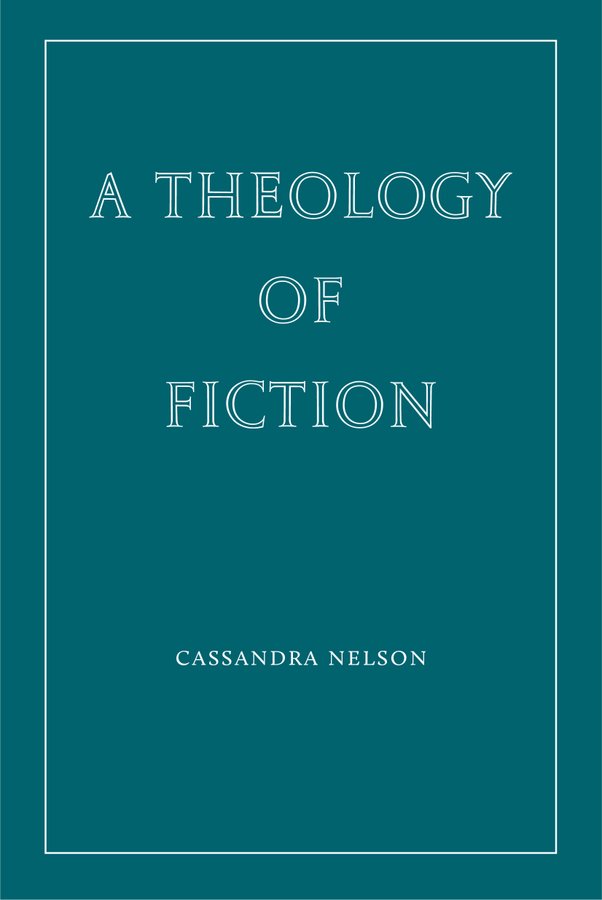
Stories often reach us in kairos time: a book will arrive just when we need it, drawing us into another duration so that we can partake of reality’s deeper designs. A Theology of Fiction (Wiseblood Books, 2025) posits that in the masterful fiction of writers ranging from Shakespeare to Muriel Spark to David Foster Wallace readers can find proof of a God whose love comes to us, sometimes through knotted, supposedly “secular” plots and seemingly profane stories, to connect us with the source of holiness, the one who writes straight with crooked lines.
Praise for A Theology of Fiction:
“A Theology of Fiction is a fascinating and subtle exploration of the intersection of fiction and faith. The book offers wonderfully nuanced readings, rich historical details on a wide range of writers, and finally delivers a sensitive evocation of what fiction, at its best, offers us as human beings.” (Phil Klay, winner of the National Book Award)
“A searching meditation on the Christian uses of fiction and the ways in which storytelling can establish a direct line into the human heart. Thoughtful and thought-provoking.” (Andrew Klavan, author of The Kingdom of Cain and host of the Andrew Klavan Show)
Works in Progress
The Selected Stories of Betty Wahl
Perhaps best known as the wife of National Book Award winning novelist and story writer J. F. Powers, Betty Wahl was also an accomplished writer in her own right. She made her debut in The New Yorker in 1947 with a short story called “Martinmas,” which Evelyn Waugh called “a brilliant sketch of convent school life which I read with relish.” Her short fiction will be collected in book form for the first time as part of the Catholic Women Writers series, published by Catholic University of America Press.
Age of Miracles: Technology and Transcendence in American Fiction
Age of Miracles uses novels by Don DeLillo, Flannery O’Connor, Walker Percy, Thomas Pynchon, and David Foster Wallace to trace the emergence of a contemporary conflation of technology and theology in the American popular consciousness. To see this conflation, one need only observe how the kind of omniscience and omnipotence once reserved for God are now seemingly available to anyone with an iPhone, or the way that “cloud computing” is marketed as a kind of data heaven (when in fact it’s neither immaterial, nor celestial, nor eternal, but rather a collection of servers, each roughly the size of a pizza box, here on earth). Age of Miracles intervenes in two critical conversations, about the roles of faith and technology in American fiction after 1945, and aims to start a third, about what constitutes “the real” in American literary realism.
Past research highlights
Flannery O’Connor, TV, and Teaching First-Year Composition
My work on Flannery O’Connor has been supported by the NEH and the Collegeville Institute. An article adapted from the first chapter of Age of Miracles, entitled “Manichaeism and the Movies: Flannery O’Connor and the Roman Catholic Response to Film and Television at Midcentury,” received the Association of Literary Scholars, Critics, and Writers’ Meringoff Nonfiction Award and was published in Literary Imagination (Oxford Journals) in 2014.
Recently, I learned at a conference that “Manichaeism and the Movies” has been used in composition classes at Catholic University of America for the past four years as a model of clear, compelling academic writing. “Without fail, my students remark on the article’s clarity and ability to engage their interest, even though most of them are not English majors, are unfamiliar with Flannery O’Connor, and have never seen or heard the term ‘Manichaeism’ before reading the article’s title,” said PhD candidate and Teaching Fellow Jessica Schnepp. “Students are visibly energized when they discover through Dr. Nelson’s article that even a researched argument is—or should be—a form of storytelling. Their careful close reading and modeling of her argument motivates them to approach their own with more clarity, precision, personal investment—and yes, even joy. For this, I am truly grateful, and I have recommended Dr. Nelson’s academic writing to my colleagues for use in their own writing classes.”
“Seeing is Believing,” an essay on O’Connor’s ethics of vision (and the distinctions she drew between human and mechanical vision), was named one of Commonweal‘s Best Book Essays in June 2017.
Textual Criticism: Betty Wahl and Samuel Beckett
For my MA thesis at the Editorial Institute under the direction of Christopher Ricks, I prepared a critical edition of stories by mid-20th-century American writer Betty Wahl, several of which were later reprinted or published for the first time in The Antioch Review, The Southern Review, and The Recorder: The Journal of the American Irish Historical Society.
In 2010, I edited Samuel Beckett’s More Pricks than Kicks for Faber and Faber, making an authoritative text of Beckett’s first published book widely available to readers and scholars for the first time. My introduction to the book can be read here.
 Cassandra Nelson